London rarely reveals itself all at once.
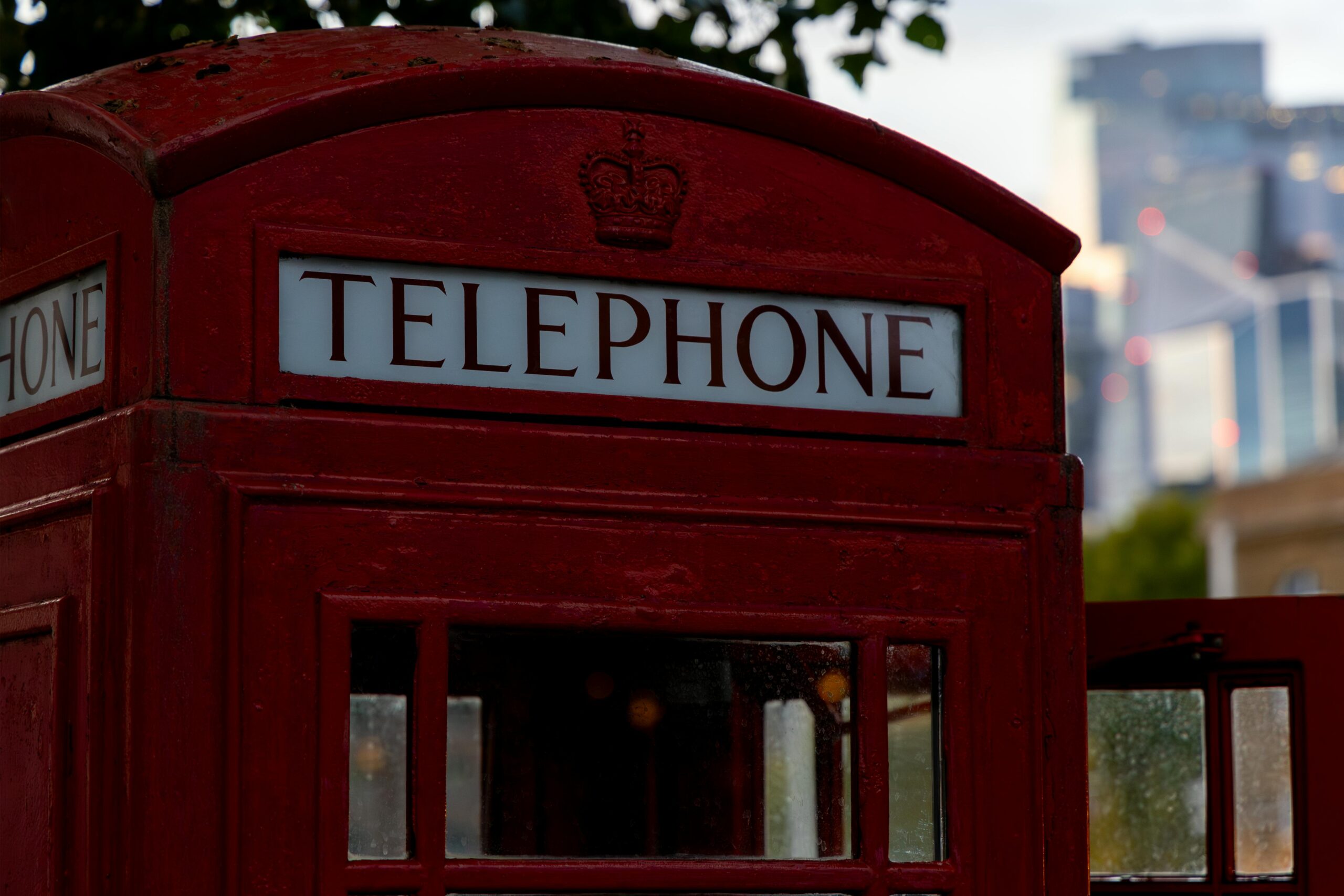
It arrives in fragments — a reflection in polished brass, the muted hum of traffic along stone façades, the unmistakable red of a telephone box standing quietly at the edge of a street that has seen more history than it cares to announce. The city does not perform for its visitors. It assumes a certain level of awareness, a familiarity with nuance, an understanding that what matters most is rarely placed in plain view.
To stay in London, properly, is to accept this rhythm.
And nowhere is that rhythm more precisely interpreted than in its hotels.
The First Signal
Arrival in London is an exercise in restraint.
There is no crescendo, no theatrical unveiling. The transition from city to hotel happens almost imperceptibly. A car slows along a curb that looks much like any other. A doorman appears without urgency. A door opens — not dramatically, but exactly when it should.
Inside, the atmosphere shifts.
The sounds soften. Light becomes warmer, more controlled. Materials — marble, wood, fabric — carry a weight that suggests permanence rather than decoration. Even the air feels different, as though calibrated to a quieter frequency.
This is the first signal.
Not that you have arrived somewhere impressive, but that you have entered a space where everything has already been considered.
A City Observed from Above
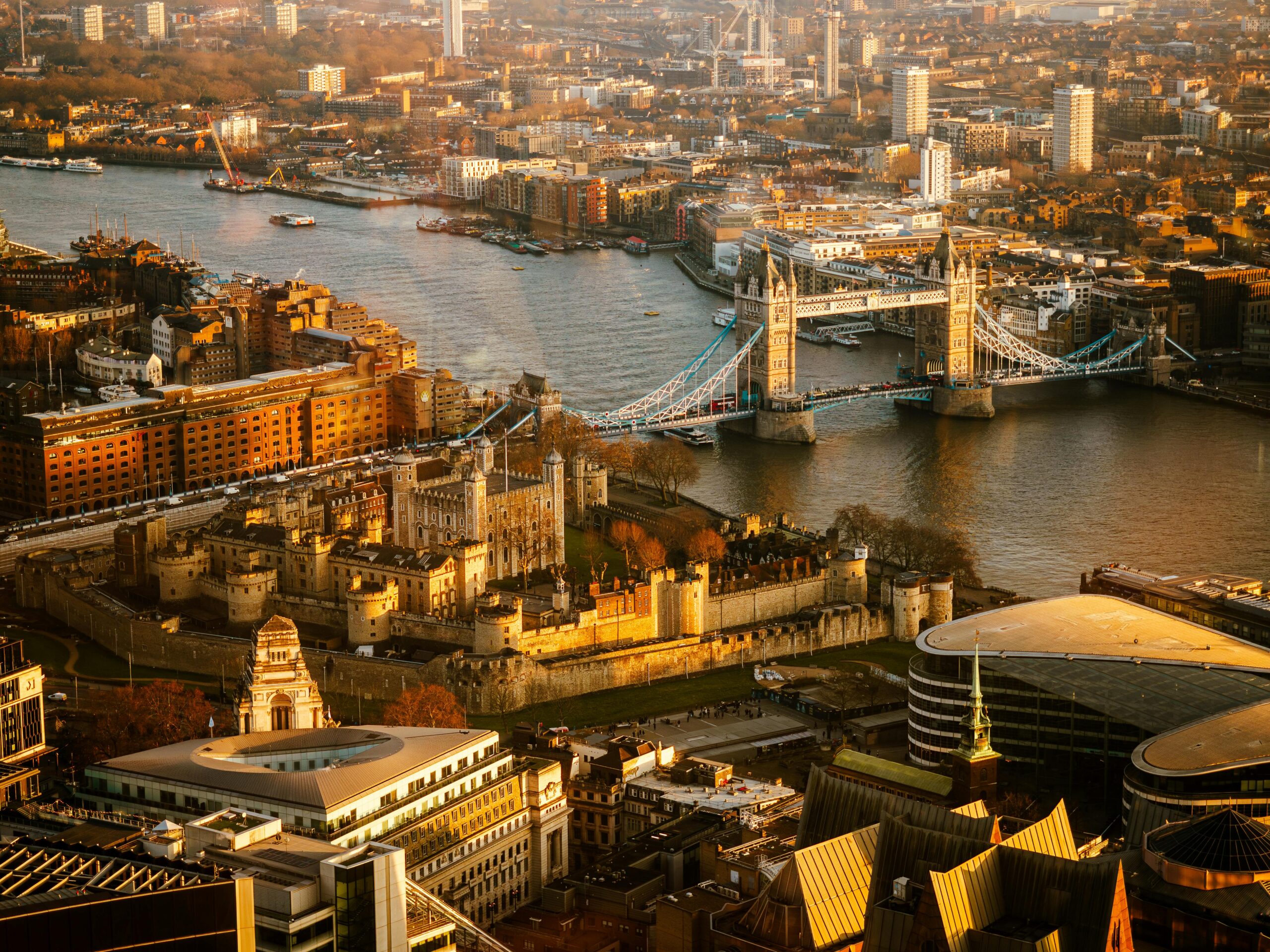
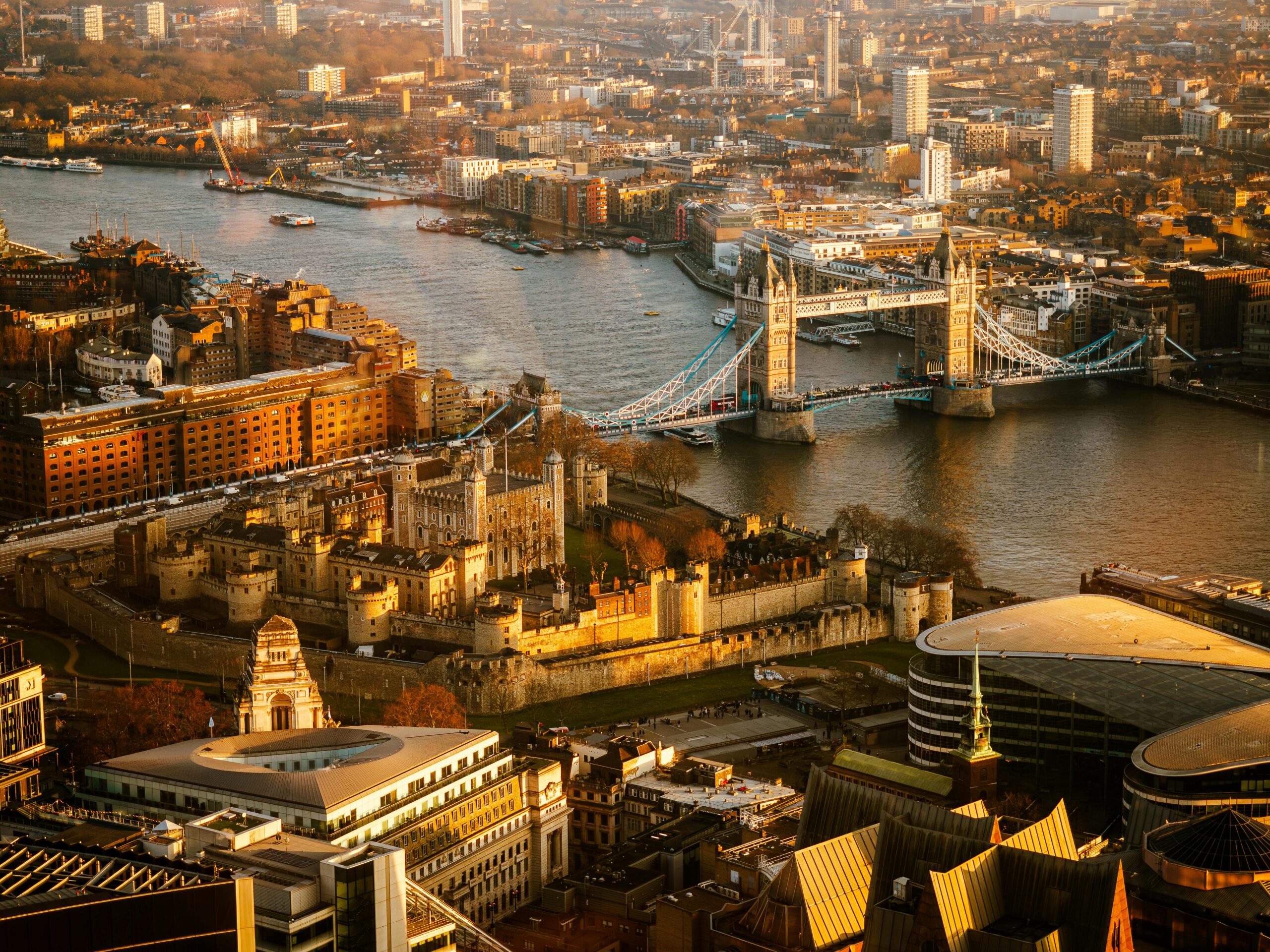
Viewed from the air, London tells a different story.
The Thames moves through it with deliberate calm, curving past centuries of architecture layered one atop the other — Georgian symmetry, Victorian ambition, modern restraint. Landmarks emerge not as isolated monuments, but as parts of a continuous fabric: the Tower, the bridges, the dense arrangement of streets that resist easy navigation.
From above, the scale becomes clear.
London is not designed to be consumed quickly. It is meant to be inhabited, understood over time, approached with patience.
And the hotels that define it reflect this same philosophy.
They are not built for passing through. They are built for returning to.
The Persistence of Tradition — The Ritz London
Some places in London do not evolve. They endure.
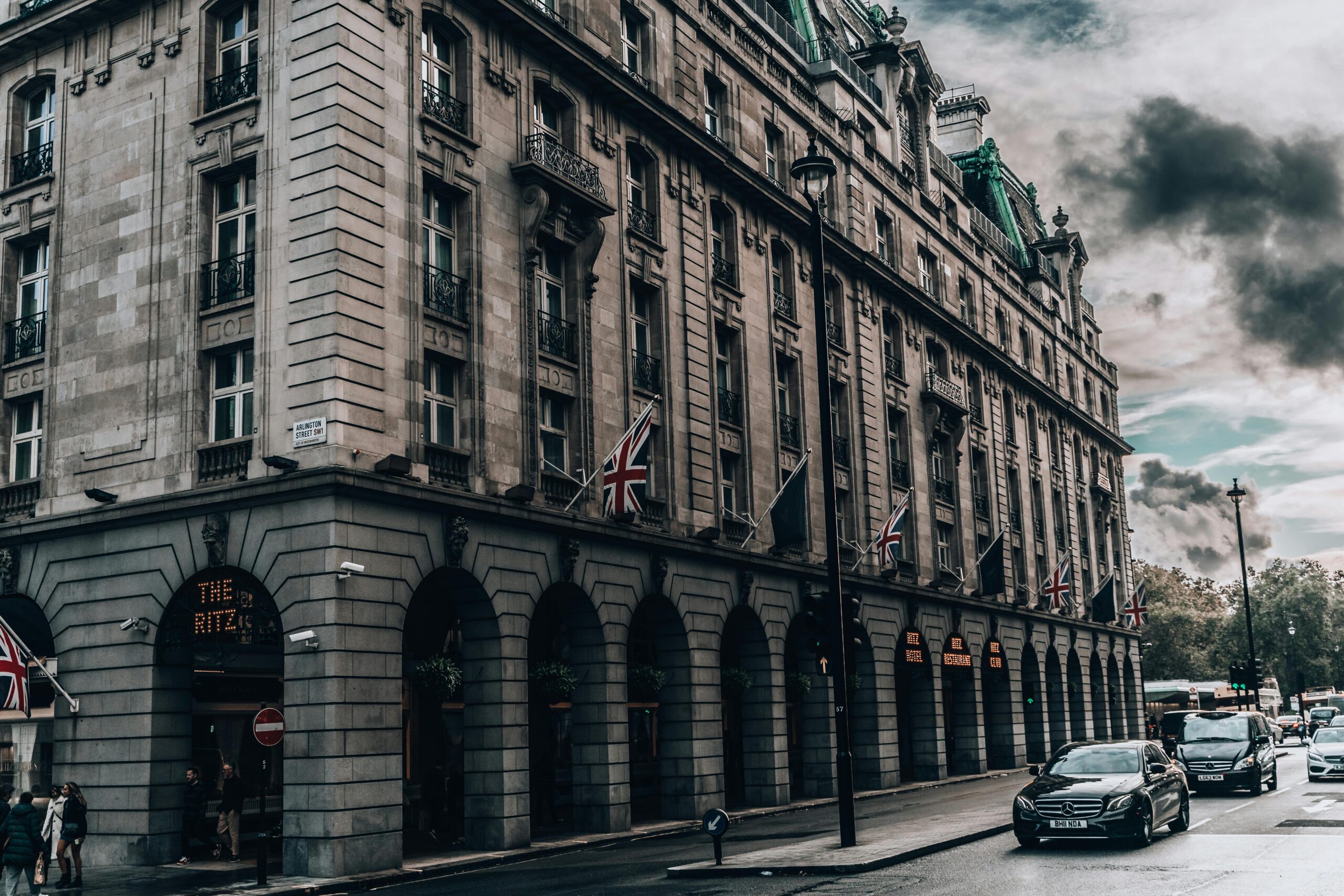
The Ritz stands firmly within this category — not as a relic, but as a constant.
Approaching its façade, one is struck less by grandeur than by proportion. The building does not overwhelm; it asserts itself quietly, with confidence rooted in familiarity. Flags move slightly in the wind, taxis pass without ceremony, and yet the entrance remains unmistakable.
Inside, time shifts.
Chandeliers cast a diffused light that softens every surface. Mirrors reflect not just space, but continuity. There is a sense that nothing here is accidental — that every object, every texture, has been placed not recently, but correctly.
Service follows the same logic.
It is formal, yes, but never rigid. Precise, but never cold. Staff move with a discipline that feels inherited rather than trained, as though each gesture has been refined over decades rather than rehearsed for effect.
To stay here is not to experience something new. It is to step into something already perfected.
Corridors and Quiet Moments
Beyond the public spaces, London’s hotels reveal their true character in the moments between.
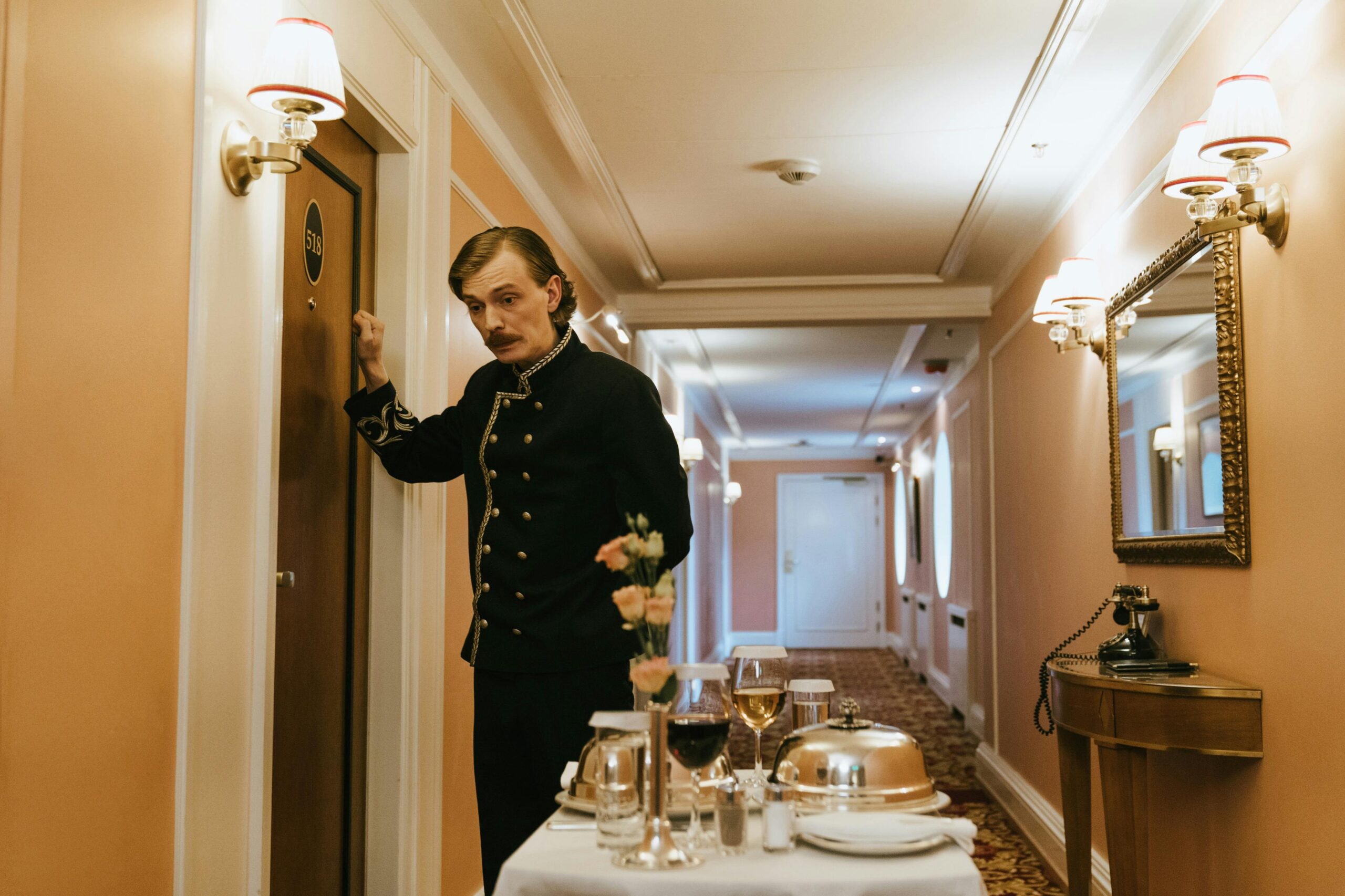
A corridor, softly lit, stretches into the distance. Doors remain closed, their presence understated. Carpets absorb sound completely, creating a silence that feels intentional rather than empty.
Somewhere along this corridor, a tray is being prepared.
Room service in London is not a transaction. It is an extension of the environment — deliberate, composed, almost ceremonial. A knock comes not as interruption, but as confirmation. Inside, the arrangement is exact: glassware aligned, linens uncreased, every element positioned as though part of a still life.
There is no excess movement. No unnecessary conversation. Once the door closes, the room returns to stillness.
These are the moments that define the stay — not the visible markers of luxury, but the absence of disruption.
The Architecture of Presence
London understands hierarchy.
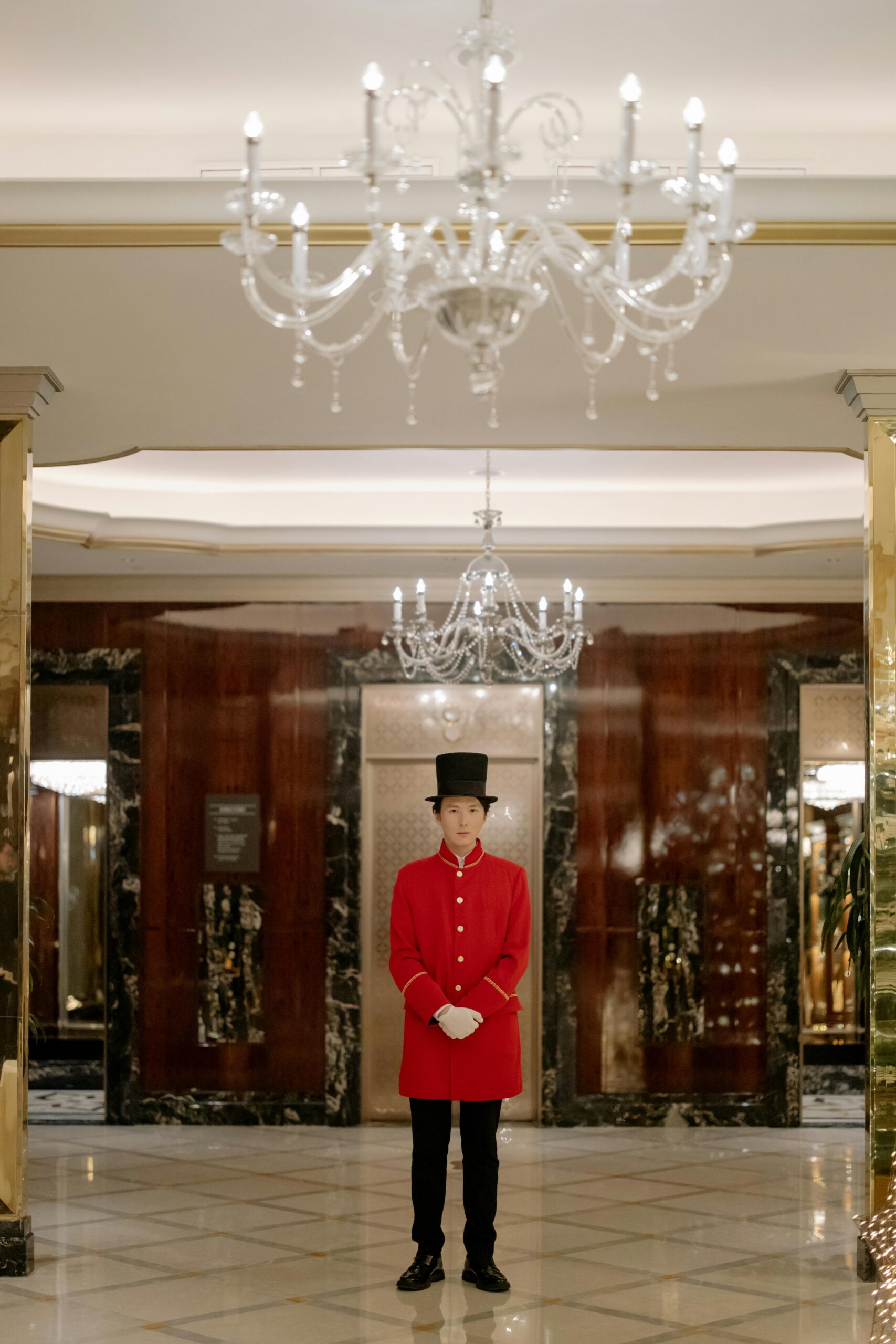
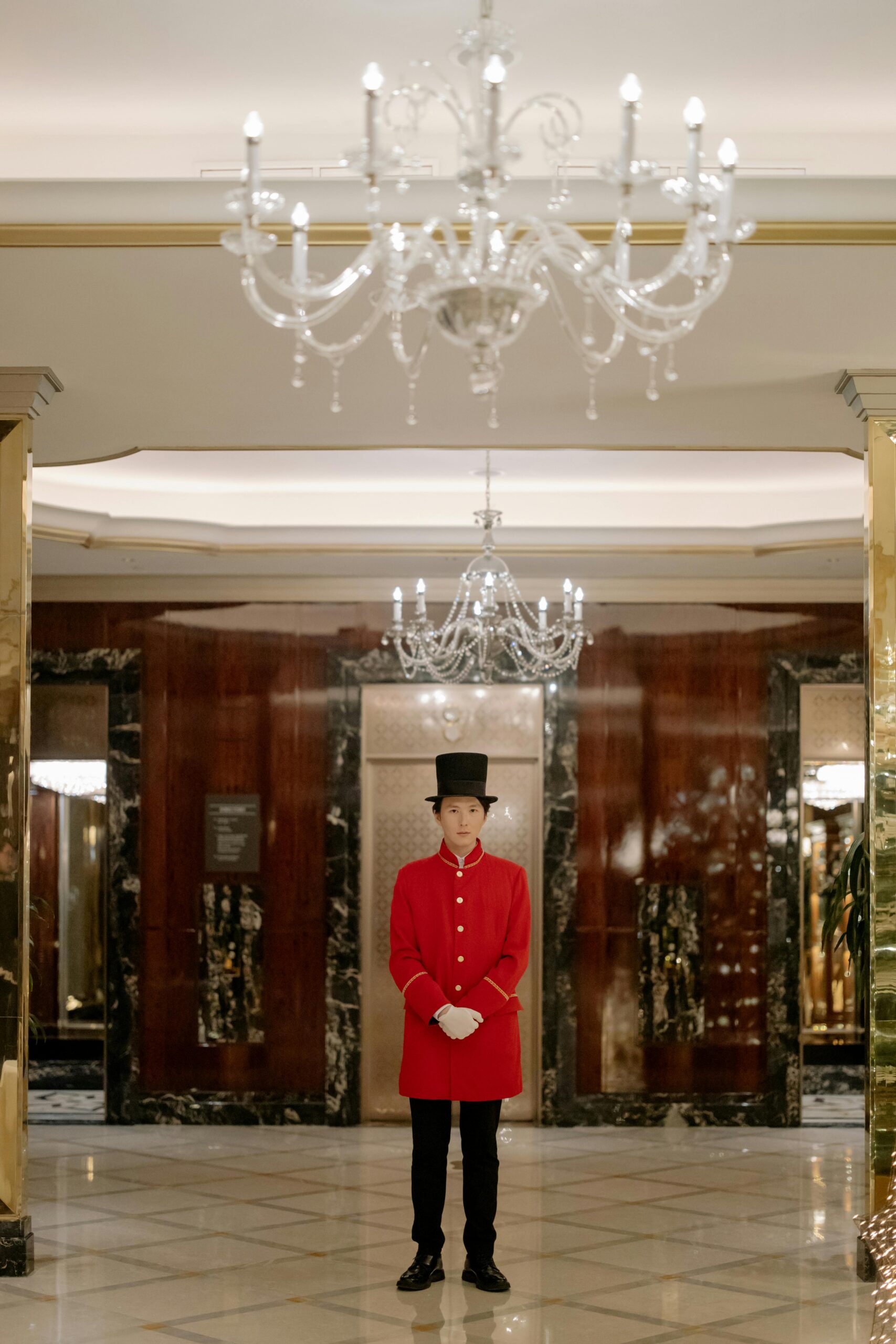
Not in the overt sense, but in the subtle layering of space and experience. The figure of the doorman, standing beneath a chandelier in a grand lobby, is not simply functional. It is symbolic — a point of transition between the outside world and an interior order governed by different rules.
The uniform is precise. The posture deliberate. The presence unmistakable.
Beyond him, the lobby unfolds with quiet authority. Marble floors reflect light without glare. Walls carry depth rather than ornament. The scale is generous, but never excessive.
Guests move through this space differently.
Conversations are lower. Movements more measured. Even time seems to slow slightly, as though the environment itself encourages a different pace.
This is not design intended to impress. It is design intended to regulate experience.
Living Within the City
For those who spend extended time in London, the idea of a hotel begins to shift.
The most sought-after accommodations are no longer those that offer the most amenities, but those that offer the most control. Spaces that feel less like temporary stays and more like private residences — environments where daily life can continue without adjustment.
In these settings, the boundaries between hospitality and living disappear.
Morning routines remain uninterrupted. Meetings happen within private spaces rather than public lounges. Evenings unfold without the need to leave the building, unless one chooses to.
Everything is arranged quietly, in advance.
Not because it has been requested, but because it is expected.
Service Without Visibility
There is a particular discipline to service in London.
It does not seek acknowledgment.
Across the city’s finest hotels, there is an understanding that the highest level of hospitality is one that removes itself from focus entirely. Staff appear when needed, disappear when not, and operate with a precision that feels almost architectural.
A room is adjusted in your absence. A preference is remembered without repetition. An arrangement is made without confirmation.
What emerges from this is not simply convenience, but clarity.
The mind is freed from small decisions. The day moves without friction. Attention can be directed outward — toward the city, toward its rhythms, toward its opportunities.
This is where London excels.
Not in what it offers, but in what it eliminates.
The Contemporary Layer
London, despite its reputation for tradition, is not static.
A newer generation of hotels has introduced a different aesthetic — one defined by restraint rather than ornament, by material rather than decoration. These spaces are quieter, more minimal, but no less considered.
Light plays a larger role. Lines are cleaner. Textures carry meaning.
Yet even here, the city’s instinct for balance remains intact.
Nothing feels excessive. Nothing feels temporary. The design does not compete with the experience; it supports it.
For those accustomed to movement between cities — New York, Paris, Tokyo — this layer of London offers familiarity without dilution. It speaks a global language, but with a distinctly local accent.
Stepping Outside
The true measure of a hotel in London is revealed the moment you leave it.
Unlike resort destinations, where the property contains the experience, London extends it outward. The transition from interior to exterior is seamless — from lobby to street, from quiet space to urban rhythm.
A short drive leads to places that are not announced, only known. Dining rooms without signage. Boutiques without display. Spaces that exist within the city, but slightly apart from it.
The hotel does not isolate you from London.
It prepares you for it.
The Enduring Choice
In the end, where one stays in London is not determined by visibility or reputation.
It is determined by alignment.
Some are drawn to the permanence of places like The Ritz — environments that offer continuity above all else. Others prefer the privacy of residential-style accommodations, where the structure of a hotel dissolves entirely. And some seek the quiet precision of contemporary spaces, where modernity is expressed without excess.
Each approach offers a different experience of the same city.
None is inherently superior.
A Final View
As the day closes, London changes again.
Lights appear gradually, reflected in glass, in water, in polished surfaces that carry the memory of the day forward. The city does not become louder. It becomes deeper, more layered, more introspective.
From a window, the view stretches outward — rooftops, streets, distant movement. Somewhere below, the same red telephone box stands as it did in the morning, unchanged, unremarkable, entirely essential to the identity of the place.
Inside, the room remains exactly as it was left.
Undisturbed. Prepared. Waiting.
This is the essence of staying well in London.
Not the sense of being hosted, but the sense of having arrived somewhere that already understands you — a place where luxury is not declared, but quietly, confidently, lived.
And once experienced, it becomes not a preference, but a standard.